To Bring Them Back
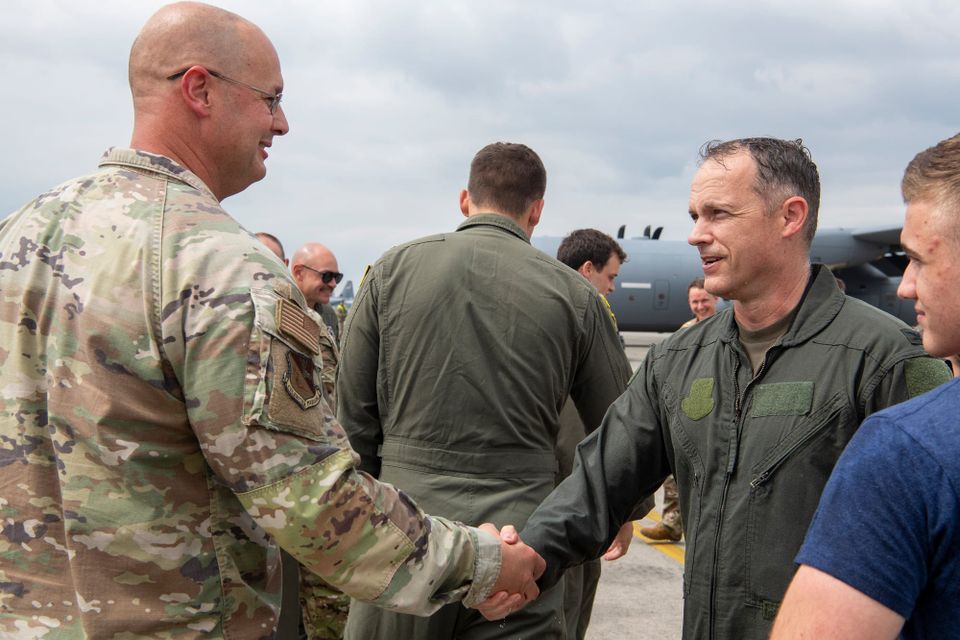
Twenty-three years ago, when I selected the C-130 as my aircraft, I did so for a number of reasons. The airframe aligns with how I view leadership: the first to go to war, versatile, inserting young soldiers into combat, resupplying them, evacuating the wounded — and the last to leave, returning these brave Americans home.
First in, last out. Leading from the front, under the radar. Hardworking, risk-accepting, get-it-done. Exacting in our knowledge and standards.
So, as I handed over the guidon this past week, I've had some time to reflect on my command these past two years and where it fits in the context of my career.
When I first arrived at Pope Air Force Base in the spring of 2004, the unit had just returned from their latest rotation supporting Operations Iraqi Freedom and Enduring Freedom. I was green, still a Second Lieutenant, and had a lot to learn. In those first few months of getting up to speed so I could deploy with the unit that summer, I was introduced to a category of instructor that was a cut above the rest. They were the leaders of the squadron. The ones the other squadron instructors and evaluators expressed an unstated deference. My first flight was with Captain Mike "Shooter" Fellona. He was and remains so polished with magnetic expertise and a calming presence. The exact person you would follow into combat. As a new pilot in a unit preparing to return to combat, I was in awe of him. I wanted to be him. I wanted to lead like him.
I don't remember the fine details of one of the most impactful days of my career. Fuzzy on the edges because the singular focus of the conversation made everything else inconsequential. Shooter was at the squadron duty desk explaining to another newer pilot why he ought to be the best he could be, and used the quote attributed to Heraclitus.
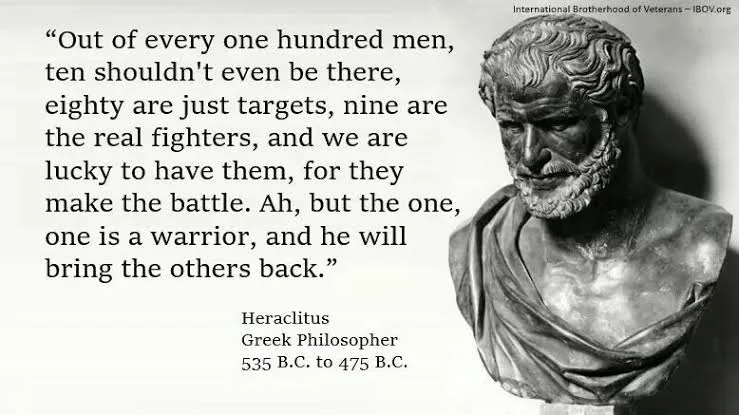
Ah, but the one, the one who will bring the others back. It wasn't about being an expert in your craft for your own sake. It wasn't about being better than everyone else so you could more easily climb the corporate ladder. It was purpose.
Your purpose is to serve others so that in the deadly business of combat, that you bring them back.
As I deployed repeatedly after that, it was crystal clear what our purpose was — to keep trucks off the road so that more Americans would live and not die by improvised explosive devices. I can't explain the silence that happens inside a noisy aircraft before you insert a plane full of Marines or Soldiers into combat. Nor can I adequately explain the electricity that is felt at cruising altitude by the hope returning to these same folks when you pull them out of combat at the end of their deployment. And likewise, there are no words for the sorrow or internal struggle of guilt one feels when you return a flag-draped coffin of these Americans. It was a clear reminder of our purpose, to bring the others back.
During that period, as a new husband, married only three weeks before my first deployment; there was a real home struggle. We were a family impacted by war, hearts torn in two from separation. And I struggled to adequately deal with my combat experience while figuring out how to be a husband and prepare for each following deployment a few weeks away. While I professionally wanted to be the "One" who would bring the others back, it was the words of a World War I soldier, Private Martin Treptow, that gave me inner strength.
My Pledge — America must win this war. So, I will work, I will save. I will sacrifice, I will endure, I will fight cheerfully and do my utmost, as if the issue of the whole struggle depended on me alone.
A decade later I gained a new perspective of service and sacrifice as a Lieutenant Colonel working in the Defense POW/MIA Accounting Agency. The agency is responsible for providing a full accounting of servicemembers unaccounted for from our nation's past wars going back to World War II. In my position, I attended numerous funerals and family member updates where I saw first-hand the impact on the families left behind, seeking closure for their loved ones who never returned home from war. I saw the tears of relief in a 90-year-old man who was given the news we had identified and returned his brother. I have held the hand of a mother who just wished and hoped for more answers on news of her son who had died during the Cold War. In this position, I realized that the pain doesn't stop for the families at home. The war may end, but the sorrow does not.
Six years later, as I prepared to depart the Pentagon for my assignment to Japan as the Operations Group Commander for the Pacific's only tactical airlift fleet, at the forward edge of America's Pacific power projection, merely ten minutes away from ballistic missile threat; I wanted to say goodbye to my friends who are buried in Arlington National Cemetery.
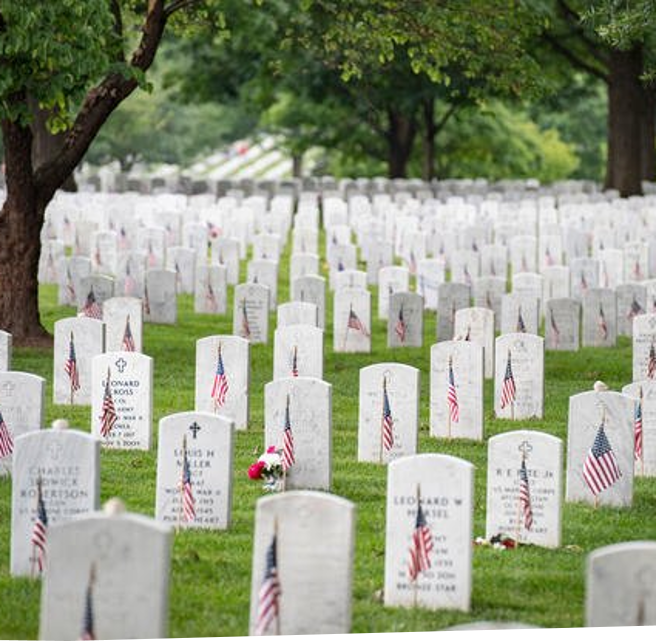
So, on Memorial Day weekend, I took my family to experience this emotional event. It was personal for me. For my family it began as a DC bucket list item. It quickly turned into a profound emotional experience. I became withdrawn. I was mentally in a different place. I was twenty years younger and halfway around the world. I wept as I went to each tombstone of my friends. And then as if a fog lifted, I noticed widows and parents spending the day graveside of their loved ones. As I looked upon those headstones in Section 60, I felt such an obligation to do my best. For them. For my friends. For their family. For the hundreds of Airmen I would be responsible for who wanted maybe nothing more than an opportunity of a better life, and the military was their path. We would ask a lot of them. They aren't thinking of future warfare. That was my job. It was my job to prepare them.
Now, two years later, I am faced with taking stock of my command. Did I prepare them enough? Were we focused appropriately on fighting the future war instead of the last one? Did I do enough? I thought I would feel regret or that I would not be able to let go. I certainly have regrets, but not the overpowering kind. I have the regrets of knowing I could do it better next time after gaining the experience I didn't bring to the table in the moment. I loved this job. I would do it for longer if I could. Yet, I didn't have these overpowering feelings. As I received my replacement at the airport and began turnover, I didn't feel any of that.
Three months ago, my Chief, the Senior Enlisted Leader of the Group, retired. He told me in the weeks after that I would be surprised at the relief I would feel and the invisible burden command carries. I thought his statement odd as I didn't think he showed any signs of burden, and I didn't feel any myself. Yet, as I prepared over the weekend for my change of command, I thought I would have to navigate feelings of sadness about all that I left unfinished. I didn't feel that. Instead, I felt relief. And it came in waves over the weekend, like the incremental removal of 10-pound plates off my shoulders.
I didn't realize the weight I was carrying in the constant checking of the phone. In the mental energy I spent constantly thinking, what next? What can we do? What do my squadron commanders need? What does my boss need? I had not felt burdened the way I imagined. My Chief was right. I could breathe easier.
The waves of relief I felt were a function of giving myself permission to allow someone else to carry the torch and move it forward. I didn't know I carried that as a weight. It wasn't a burden. I want to carry it still—just in a different capacity. And that's okay. That's great. My talents and experience will continue to make things better. But this one is not mine to carry anymore. It is with this realization that I had the overwhelming feeling that things were going to be okay. I was going to be okay. The Group was going to be okay. My anxiousness in wanting to prepare my replacement for command, didn't need to be there. He was going to be okay. I had done my part. There were things I had done and left undone. And he will pick that up and do the same. The Air Force and our Airmen will be better with a commander with fresh eyes and energy and a different career experience to push the ball forward.
In this relief, as I handed over the guidon I felt gratitude. I felt gratitude to my spouse, who had sacrificed so much over the course of our career. She had worked and saved and sacrificed and endured. It is not easy to be a military spouse when you have to reshape your identity at every move and assignment. It is heart wrenching to lose your support structure every two years and to reconstruct routines and leave successful jobs. All the core items that form one's identity gets destroyed with every move. Yes, I felt gratitude for my wife. I felt gratitude to my children who similarly experience the same but as teenagers; as if that isn't punishment enough. They must also do this while living in a fishbowl, knowing that every mistake is highlighted. They must live up to a maturity that is often not fair. But they did, and did it well.
I was thankful for my staff. I spent more time with them than my family these past few years. They often received the best of me and my family the worst. An unfair trade. No amount of success or progress is really achieved on one's own. They made sure the group and our Airmen were taken care of. I could not have done this job without them.
So, while Heraclitus's quote appropriately focuses a warrior's professional attention, it is not the whole story. I will continue to work as if the whole endeavor is dependent upon me alone. I will sacrifice and endure and sharpen my mind for combat. But I will continue to do so with the understanding that families serve too and sometimes long after the servicemember has paid the ultimate price. Their cost is greater. My family serves, sacrifices, and endures. They are the ones who allow me to spend my life in a worthy cause to bring others back. And as I end my command, I am incredibly thankful.



Member discussion